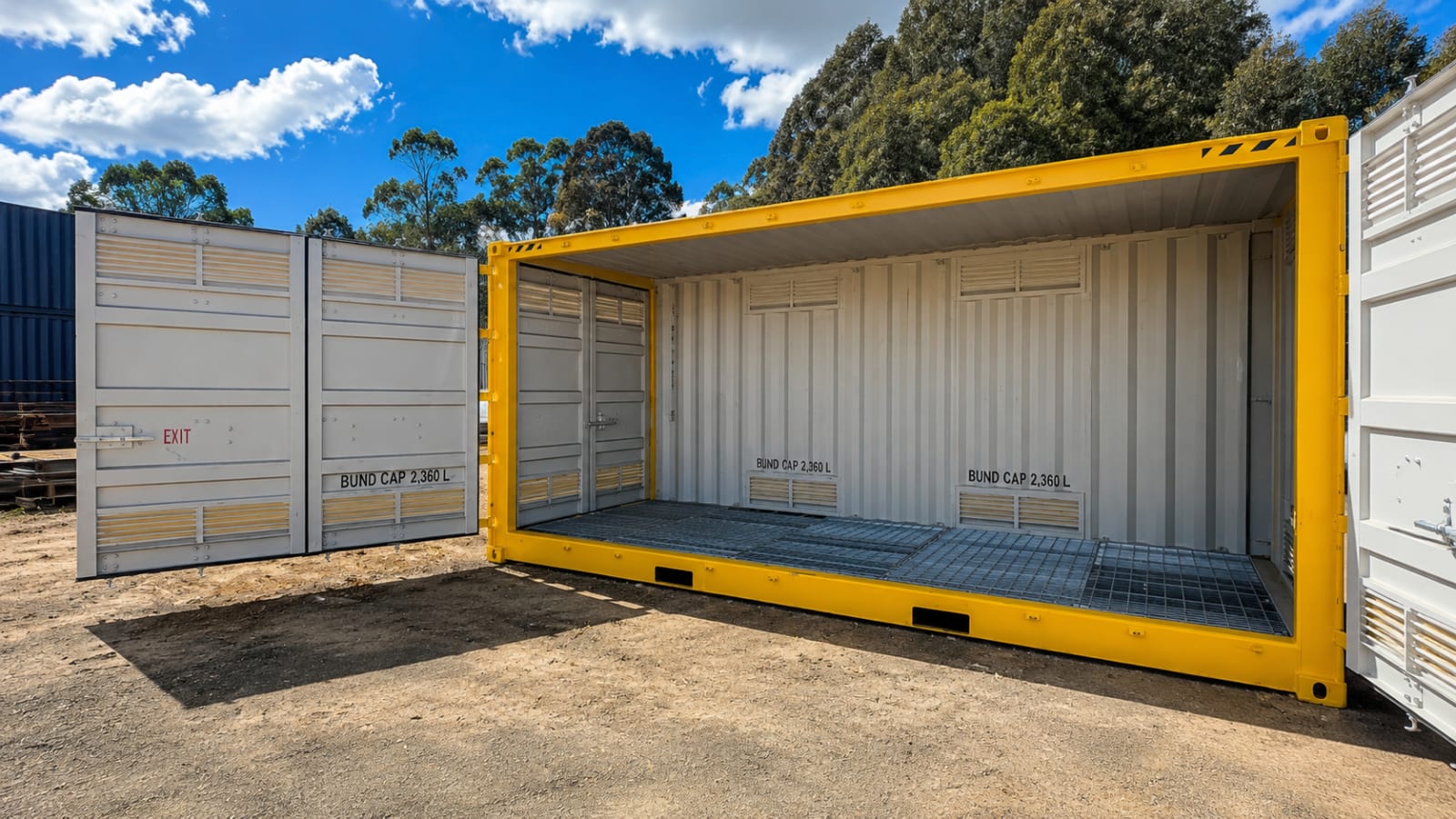
Bunding becomes mandatory once the stored quantity exceeds the relevant state's placard quantity under the WHS Regulations. Below that threshold, bunding is best-practice spill prevention rather than a legal requirement. Placard quantities are set in Schedule 11 of the model WHS Regulations and adopted by each state regulator, so confirm the figure that applies to your jurisdiction and your DG class with SafeWork Australia before you specify a store.
Above the threshold, the controlling standard sets how big the containment must be. For flammable and combustible liquids, AS 1940:2017 sizes secondary containment to the greater of 100% of the largest single container or 25% of the aggregate stored volume. Environment regulators commonly apply a stricter figure of 110% of the largest container, so a site near a drain or a watercourse is often built to the higher of the two rules. For corrosives, AS 3780:2023 sets a sump at least 150 mm deep holding at least 25% of the aggregate. The DG compliance and classification guide works through the class-by-class detail, and our container certification standards cover third-party inspection of the build.
When bunded storage is the right call
A bunded store is the right call when the inventory sits above the placard quantity, when the store has to relocate, or when the site has no existing engineered compound. Relocatable stores are the clearest case, because an integrated bund keeps the unit compliant on every pad it moves to. Sites near stormwater drains or watercourses come next, where the environmental consequence of an uncaptured spill is high. Remote operations carry it too, where building and certifying a civil compound is slow and costly. Class 3 bunded storage and Class 8 corrosive storage both ship this way, and for remote work see dangerous goods storage for mine sites.
When unbunded storage can be acceptable
Unbunded storage can be the correct and compliant choice in several cases. Below the placard quantity, secondary containment is best practice rather than a legal requirement, so a low-hazard, low-volume inventory may not need a built-in bund. A site with an existing engineered compound that is sized to the inventory and maintained already meets the secondary-containment requirement, and a separate bunded store inside it adds little. Short-term indoor storage of low-hazard goods, backed by adequate spill kits and a documented response plan, is another. The test is whether a maintained external system genuinely provides containment equal to what the standard asks of a built-in bund.