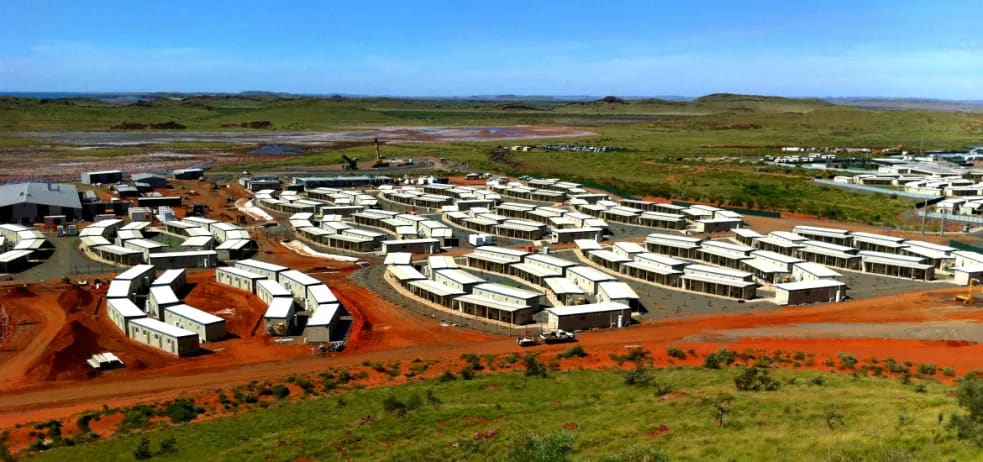
Guide

The SCS Global Container Production Line: Factory Capability & Capacity

SCS runs a vertically integrated container production line at its own factory in Yixing, Jiangsu, China, taking units from steel processing through welding, coating and final inspection. We own and operate the factory, employ 320 staff, and cast our own structural fittings on site. What follows is a factory tour in text: capacity, equipment, what we cast in-house and how an order moves from enquiry to delivery.

Summary

The SCS line is vertically integrated: steel processing, corrugation, welding, coating and final inspection all happen on one site in Yixing, Jiangsu, China, under one accountable team. The factory runs four dedicated assembly lines across roughly 50,000 square metres, producing 300 to 500 container-equivalent units a month and more than 50,000 units since 2001. It is sized for engineering-led mid-sized and custom orders, the 20 to 50 unit range where a buyer needs design input, not just boxes off a press. This guide sits alongside our manufacturing & quality assurance pages at SCS Global, covering the product specifications and compliance documentation that support the same procurement audience.

01

The line

Inside the SCS production line

The SCS line is vertically integrated: steel processing, corrugation, welding, coating and final inspection all happen on one site, under one accountable team. That integration is the point, because it is what lets us hold quality across very different products on shared lines.

We frame the line as engineering-led rather than commodity-scale. High-volume commodity plants chase throughput. Our edge is service and engineering on mid-sized and custom orders, the 20 to 50 unit range where a buyer needs design input, not just boxes off a press. The line builds to the ISO 668 dimensional standard and the structural type-tests behind it, so a standard box and an engineered unit share the same fabrication discipline. You can follow the actual build, stage by stage, in how our containers are made. The sections below cover where the factory sits, what it can produce, the equipment on the floor, and the structural parts we cast ourselves.

02

Location

Where the factory is and how it's organised

SCS owns and operates its factory at 9 Yidu Road, Guanlin Town, Yixing City, Jiangsu Province, China, with a Hong Kong commercial head office. The factory has run since 2001 and exports to more than 60 countries.

It is worth being precise about structure, because buyers ask. Hong Kong is the commercial office, and Yixing is the factory. Some buyers call it a shipping container manufacturing plant, and that is fair: it is a working plant of about 50,000 square metres with 320 staff. Buyers searching "container factory china" are usually doing supplier due diligence, and the honest distinction is ownership. We own and run the line and cast our own fittings, rather than booking space in someone else's plant. That is the difference between a manufacturer and a broker. For the company background and the homepage-level view of our shipping container factory, the homepage carries the wider story, and this page stays on capability.

03

Capacity

Production capacity and line layout

The Yixing factory runs four dedicated assembly lines across roughly 50,000 square metres, producing 300 to 500 container-equivalent units a month and more than 50,000 units since 2001. The four lines split across standard ISO, high-cube, custom and modular, and heavy industrial work.

The shipping container manufacturing plant capacity that matters to a buyer is not peak throughput, it is whether the factory can take a mid-sized engineered order without it sitting behind a commodity run. Splitting the work across four lines is what lets a 30-unit custom build progress while standard production continues. These figures describe an engineering-led mid-sized manufacturer, not a commodity giant, which is the deliberate position: we compete on engineering and service, not on stamping the highest possible number of identical boxes per day. That posture is what suits the 20 to 50 unit orders where service and design input decide the outcome.

Splitting the work across four lines is what lets a 30-unit custom build progress while standard production continues.

04

Equipment

Equipment: CNC cutting, corrugation, robotic welding, paint

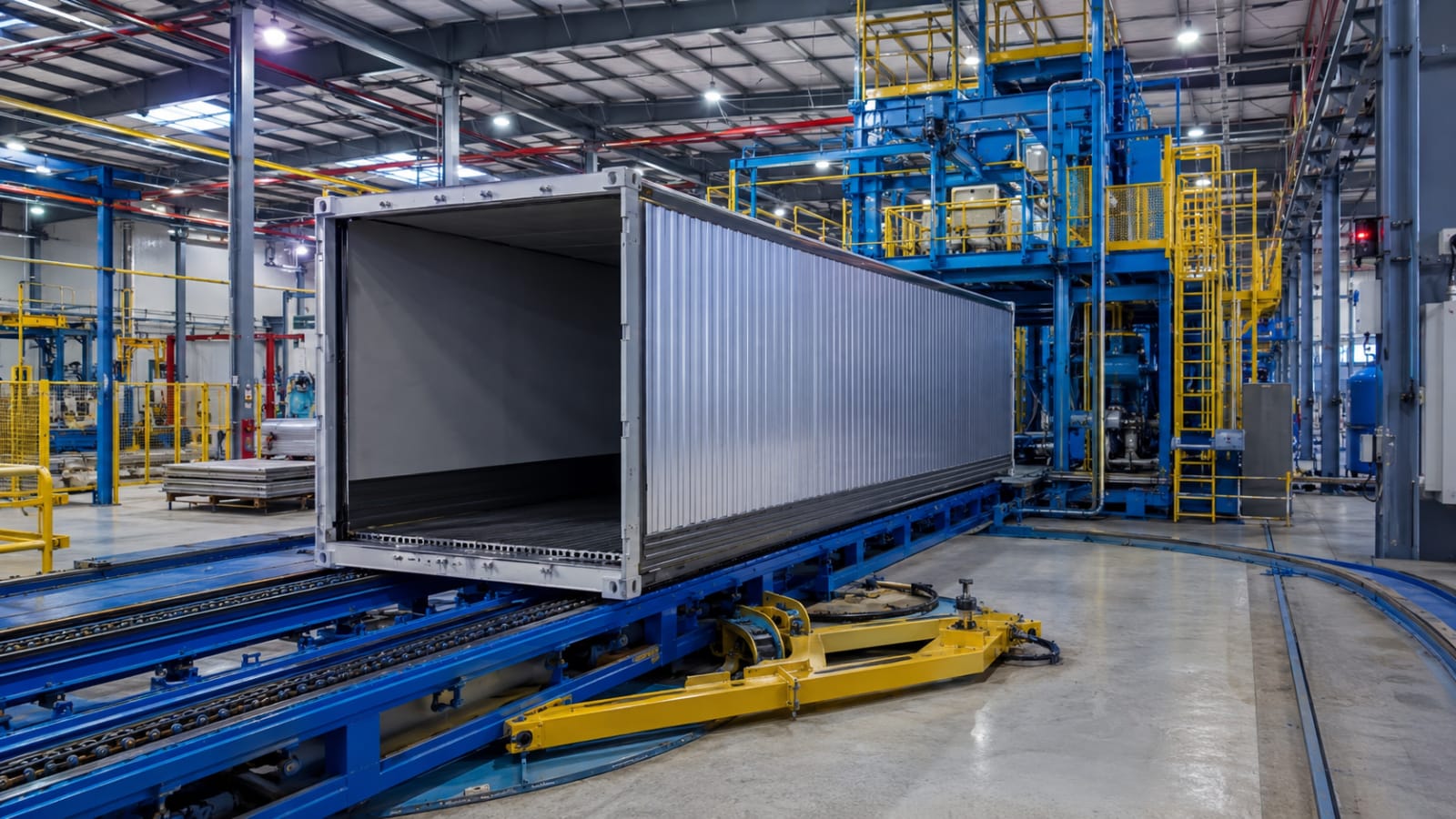
The line carries the full fabrication chain: CNC cutting, corrugation pressing, robotic and manual welding, shot-blasting, marine coating and, for custom units, mechanical and electrical fit-out. Equipment is described here by type, because the capability matters more than the brand on the machine.

In-house CAD modelling, structural design and Factory Acceptance Testing sit alongside the line, so an engineered unit is drawn, built and tested under one roof. Each unit is fabricated to the ISO 668 envelope and the type-tests behind it, which keeps a custom build dimensionally interchangeable with standard freight equipment.

Production-line stations at a glance

  1. CNC plasma and laser cutting, plate preparation and structural steel shaping, with automated measurement and calibration
  2. Hydraulic corrugation press for wall and roof panels
  3. MIG/TIG and robotic welding cells, including door-frame and corner-casting integration
  4. Shot-blast booths preparing steel to a clean substrate before coating
  5. Marine coating and two-component epoxy paint, with dry-film thickness checked by calibrated gauges
  6. Mechanical and electrical integration for custom units: wiring, control panels, distribution boards, switchgear, HVAC, ventilation and fire systems
05

Foundry

What we cast in-house: corner castings and structural components

SCS casts its own ISO 1161 and offshore-grade DNV corner castings, padeyes, lifting lugs and lashing gear in our own foundry, the structural parts most container makers buy in. SCS-cast components are used by other manufacturers, including CIMC.

This is the capability that is hardest to copy and easiest to verify. The castings are the certified lifting and stacking points of every box, made to ISO 1161 geometry, and because we cast them ourselves the parts that carry every lift are made and traced on the same site that welds them in. Most factories order these in from a third party and inherit whatever quality arrives. We control the metal, the geometry and the traceability end to end. The same foundry produces the heavier fittings on offshore-grade castings and DNV containers. For a procurement team weighing supplier risk, an in-house foundry is a concrete answer to the question of how deep a manufacturer's control really goes.

06

Capability

Factory capability for mid-sized and engineered orders

SCS factory capability is built around engineering-led custom and mid-sized production runs, from single specialised units to large rollouts, across nine product categories on shared lines. The competitive edge is engineering and service, not commodity volume.

The lines handle standard ISO, high-cube and side-opening boxes, custom height and width builds, modular building frames and heavy industrial enclosures, plus OEM and white-label runs where the client's logo, paint, specification, serial system and documentation are applied. The container factory capability buyers actually need on a mid-sized order is design input, a prototype, and a factory that will not bury a 40-unit job behind a commodity run, which is where our model fits. Engineering capability is part of it too: in-house engineering and design services take a unit from CAD model to tested prototype to series production. The point is range with accountability: many product types, one factory, one team answerable for the result.

07

Process

From enquiry to delivery: the 10-stage process

SCS runs an order through ten stages, from operational assessment to ongoing support, with a prototype-and-testing gate before any series production begins. That gate is what separates an engineered build from a commodity order. The prototype gate at stages six and seven means a custom design is built and tested under real conditions, then refined against the results before the full run commits. Coordinated delivery ties into global shipping from the factory, so the unit that leaves the line reaches site as one managed handover rather than a series of disconnected steps.

The ten stages

  1. Operational assessment of the requirement
  2. Custom design and cost estimate
  3. Detailed engineering design
  4. Design sign-off and quote
  5. Prototype scheduling
  6. Prototype production and testing
  7. Design and product review against test results
  8. Series production, flexible across small and large volumes
  9. Coordinated delivery
  10. Operations and ongoing support
08

Audit

Factory certifications and third-party audit

The factory is independently audited by ABS, DNV, Lloyd's Register and Bureau Veritas, covering welding procedures, material traceability, lifting systems, structural integrity, coatings and final inspection. ISO 9001, 14001 and 45001 management systems govern quality, environment and safety.

Third-party audit is the external check on everything above. ABS, DNV, Lloyd's Register and Bureau Veritas audit the facility, and the ISO 9001 quality system underpins the records. Designs are also aligned to UIC standards where units are rail-carried and to Australian Standards for AU and mine-spec builds. The full inspection regime that sits behind these audits, stage by stage, is set out in our QA/QC protocol. For a buyer, the audit trail is what turns capability claims into something independently verified.

Standards & references

The standards behind the line

The factory builds and is audited against the standards below. Follow any link through to the source authority for the current revision.

ISO 668 Series-1 freight container dimensions and ratings: the envelope every unit is fabricated to. ISO
ISO 1161 Corner-fitting geometry: the certified lifting and stacking points cast in the in-house foundry. ISO
ISO 9001 Quality management system that underpins the production and inspection records. ISO
Factory audit The Yixing facility is independently audited by ABS, DNV, Lloyd's Register and Bureau Veritas. ABS / DNV / LR / BV

Expert perspective

Capacity versus throughput

“The shipping container manufacturing plant capacity that matters to a buyer is not peak throughput, it is whether the factory can take a mid-sized engineered order without it sitting behind a commodity run. Published capacity numbers tell you the maximum; throughput is what actually ships, and throughput depends on product mix, shift pattern and client schedule. Splitting the work across four dedicated lines is the deliberate position that lets a 30-unit custom build progress while standard production continues. We compete on engineering and service, not on stamping the highest possible number of identical boxes per day, which is exactly what suits the 20 to 50 unit orders where design input decides the outcome.”

Managing Director Adam Baker

Related pages

More guides and products

More from our manufacturing & quality assurance pages: additional guides that deepen the planning picture, plus the commercial starting point when you are ready to scope a specific unit.

Next step

Talk to an engineer about your build

Custom, mid-sized or a full rollout, the same line and team handle it. Tell us the product line, unit count and destination and we will scope your order against the right line and lead time.