
Engineering & sign-off
ISO and non-ISO drawings, load and compliance data, and fit-out schematics, signed off before manufacturing starts.
Global Shipping & Logistics
We deliver containers and modular buildings factory-direct to more than 60 countries. The same team that engineers and builds your units documents and ships them, with no broker or freight forwarder in between.

Factory-Direct
We are a vertically integrated manufacturer, not a broker or trader. We own the production, control the engineering and run QA/QC end to end, building from one integrated facility at Yixing, Jiangsu since 2001, with 320 staff and 25+ years behind us.
One party engineers, builds, inspects, documents and ships each unit, so there is no factory-to-trader hand-off where specification drift and delays start. Mid-shipment, you deal with the manufacturer that made it. The full build is on our manufacturing and QA page.
The detail
The freight methods and the remote-site chain, each on its own page.
The process
Five stages from order to site, all under one roof. Because the same manufacturer runs the production and delivery schedules, multi-unit rollouts of 20 to 50 units, our sweet spot, stay sequenced to your build programme and arrive in the order the site needs.
ISO and non-ISO drawings, load and compliance data, and fit-out schematics, signed off before manufacturing starts.
Structural, electrical, plumbing, paint, weld and fit-out inspections, with third-party or client inspections welcome at the factory.
ISO units loaded directly; oversized modules placed on the freight method that fits them, the load optimised to reduce cost per unit.
Commercial invoice and packing list, HS codes, CSC plates, Certificate of Origin where required, and the QA/QC photo pack.
Door-to-port, barge and remote delivery, and multi-site rollouts, with the records behind each shipment held by the manufacturer.
Remote delivery
We reach remote and off-grid sites by barge, heavy-haul road and last-mile coordination. Because the lifting, securing and offload features are designed in with the module, the unit is built for the chain it travels, not adapted to it at the freight stage.
Barge handles the shallow-port or island water leg, landing units where there is no large port crane.
Heavy-haul road moves over-dimensional loads on the highway leg under oversize permits, with pilots and escorts above set thresholds.
Last-mile transfer takes units onto unsealed or haul roads for the final run to the pad.
A route survey checks bridge limits, clearance, pavement load, turning radii and gradient before dispatch.
Integrated lifting lugs let a mobile crane or HIAB self-offload the unit where there is no yard crane.
SCS coordinates specialist barge and heavy-haul operators and engineers the unit for the journey, not an owned fleet.
“Remote delivery is engineered in at the design stage, not improvised at the freight stage.”
Freight methods
Compliance & certification
Most units, including modular building systems shipped as individual modules, leave the factory CSC-plated and travel through CSC-compliant channels. Only items that genuinely exceed the ISO envelope ship under engineered securing instead, with a Verified Gross Mass declared under SOLAS. We quote under Incoterms 2020, FOB, CFR, CIF or EXW. Every shipment carries a full export pack, the commercial invoice and packing list, HS codes, CSC plates, a Certificate of Origin where required, test reports, method statements and a QA/QC photo pack, prepared by the team that built the units.
 ISO 9001
  Bureau Veritas
  DNV
DNV  Lloyd's Register
  BIC
BIC  ABS
ABS Delivery network
Sea freight, port-to-port from China, in weeks. Add 1 to 2 weeks for handling and customs. Industry-typical, not SCS guarantees.
| Destination | Factory → Site |
|---|---|
| South-East Asia | ~1–2 weeks |
| Oceania (AU / NZ) | ~3–4.5 weeks |
| Middle East | ~3–4 weeks |
| Europe | ~4–6 weeks |
| Africa | ~4.5–6 weeks |
| North America (W / E coast) | ~2–3 / ~5–6 weeks |
| South America | ~5–8 weeks |
We ship to project sites across seven regions, a representative sample of the 60+ we deliver to: Oceania, Asia, the Middle East, Africa, Europe, North America and South America. The named network drives the markers on the map.
One accountable manufacturer runs the build and the shipment to each of them, so the documentation and the schedule stay ours to answer for, wherever the site is.
Sea-freight transit varies by lane. The table shows indicative, industry-typical port-to-port ranges from China, not SCS guarantees; add roughly one to two weeks for port handling and customs at the destination.
Standards & references
Every unit we ship is documented against the standards below. Follow any link to the source authority.
Products supported
Our global shipping capability gets every SCS product line to site, factory-direct.
Dongas, ablution blocks, kitchens and modular camps, delivered to remote mine sites worldwide.
Explore the clusterDNV 2.7-1 offshore containers and oilfield units, shipped as project cargo to coastal and island sites.
Explore the clusterBunded DG storage units inside the ISO envelope, CSC-plated and shipped FCL.
Explore the clusterOversized switchroom and control-room modules shipped on flat rack under engineered securing.
Explore the clusterISO-based site offices and workspace units that ship FCL like any standard container.
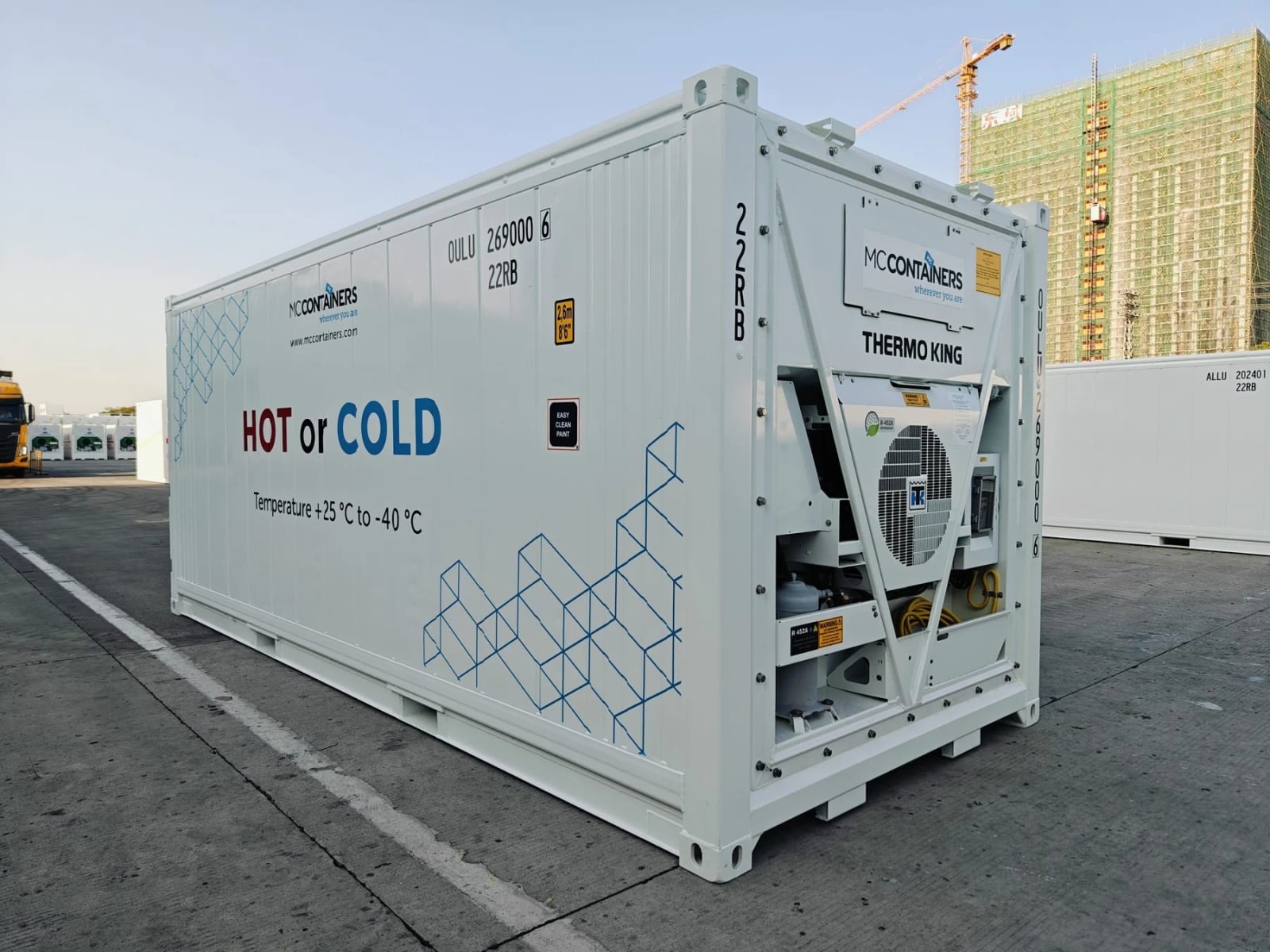
Explore the clusterReefers and cold-storage units shipped within the standard container system.
Explore the clusterStandard 20ft and 40ft units, the FCL baseline for the rest of the range.
Explore the clusterIndividual CSC-plated modules that ship as standard containers and clip together on site.
Explore the clusterFAQ
The questions procurement teams ask most. For the full picture, follow the links to the two pages above.
More than 60 countries across Oceania, Asia, the Middle East, Africa, Europe, North America and South America. If your destination is not on the published sample, ask us, because the network is broader than the list shown.
No. SCS is a factory-direct manufacturer that ships what it builds. We engineer, build, QA and document the units, then coordinate delivery, so one accountable party runs from drawing to handover rather than a build supplier and a separate logistics broker.
By combining sea freight with a barge final leg and road haulage. Barge lands units where there is no large port crane, and integrated lifting lugs let them be offloaded without one. The full method is on the remote-site and last-mile delivery page.
Most of what we build, including modular building systems shipped as individual modules, leaves the factory CSC-plated, as required for international intermodal transport. Only the minority of items that genuinely exceed the ISO envelope ship as project cargo under engineered securing and a Verified Gross Mass declaration instead.
It depends on the lane. Indicative port-to-port from China runs about one to two weeks to South-East Asia, three to four-and-a-half to Oceania, four to six to Europe, and five to eight to South America. Add one to two weeks for port handling and customs. These are industry-typical figures, not guarantees.