Steel PA door
Personnel access door with handle and deadlock. Ships in a 20ft container.

6m x 3m footprint (5,960 x 3,000 mm) in flat (R1R), skillion (R1S) and pitched (R1T) roof. 4.5 mm galvanised main structure, 2.3 mm beams and arms, 1.2 mm base joists and roofing members, four-layer powder-coated. 8 lifting points on every profile. Crate 535 to 630 kg, flat-packed, one kit fills a 40ft container.
A container frame is a structural component, so compliance sits with the completed building. In Australia that means NCC 2022, with cold-formed steel design to AS/NZS 4600, load actions to AS/NZS 1170, and galvanised corrosion protection to AS/NZS 4680. Final building approval rests with the local council.
Bolt-together galvanised steel, no welding, assembled in a few hours. Flat-packed in a steel crate with 8 lifting points, so it lifts off the truck without hand loading. Takes a 19 or 25 mm subfloor, 50 mm EPS or framed walls, and a Colorbond roof. Frames join side-by-side or end-to-end and can be cut to size.
Key Features
Specifications
SCS builds the container frame range on one 6m x 3m footprint in three roof profiles, all from galvanised steel with a four-layer powder coat, supplied as a bolt-together kit that ships flat-packed in a steel crate. One kit fills a 40ft container.
| Specification | Value |
|---|---|
| Range | Flat (R1R), skillion (R1S), pitched A-frame (R1T) |
| Footprint (external L x W) | 5,960 x 3,000 mm (6m x 3m) |
| R1R flat (external L x W x H) | 5,960 x 3,000 x 2,700 mm |
| R1S skillion (external L x W x H) | 5,960 x 3,000, 2,650 (low) / 3,000 (high) mm |
| R1T pitched (external L x W x H) | 5,960 x 3,000, 2,720 (low) / 3,070 (high) mm |
| Main structure | 4.5 mm galvanised steel |
| Beams and arms | 2.3 mm galvanised steel |
| Base joists and roofing members | 1.2 mm galvanised steel |
| Coating | Four-layer powder coat over galvanised steel |
| Lifting points | 8 (all profiles) |
| Assembly | Bolt-together, no welding |
| Crate dimensions | 5,750 x 750 x 400 (R1R) / 5,750 x 750 x 470 (R1S) / 5,750 x 720 x 600 (R1T) mm |
| Crate weight | 535 kg (R1R) / 590 kg (R1S) / 630 kg (R1T) |
| Shipping | Flat-packed, one kit fills a 40ft container |
| Container included | New 40ft High Cube with every FlexiFrame order, and a new 20ft GP (20NGP) with shower-module and PA-door orders |
| Compatible build | 50 mm EPS wall panels, Colorbond roof, 19 or 25 mm flooring |
| Compliance | NCC 2022, AS/NZS 4600, AS/NZS 1170, AS/NZS 4680 |

Overview
A container frame is the steel skeleton of a building, supplied as a bolt-together kit rather than a finished structure. Buyers searching for a shipping container frame want the frame on its own: the posts, beams and roof members that carry the load, ready to clad and fit out. SCS supplies that as a container frame kit on a 6m x 3m footprint, in galvanised steel rather than timber. You add the walls, roof and floor.
Roof Options
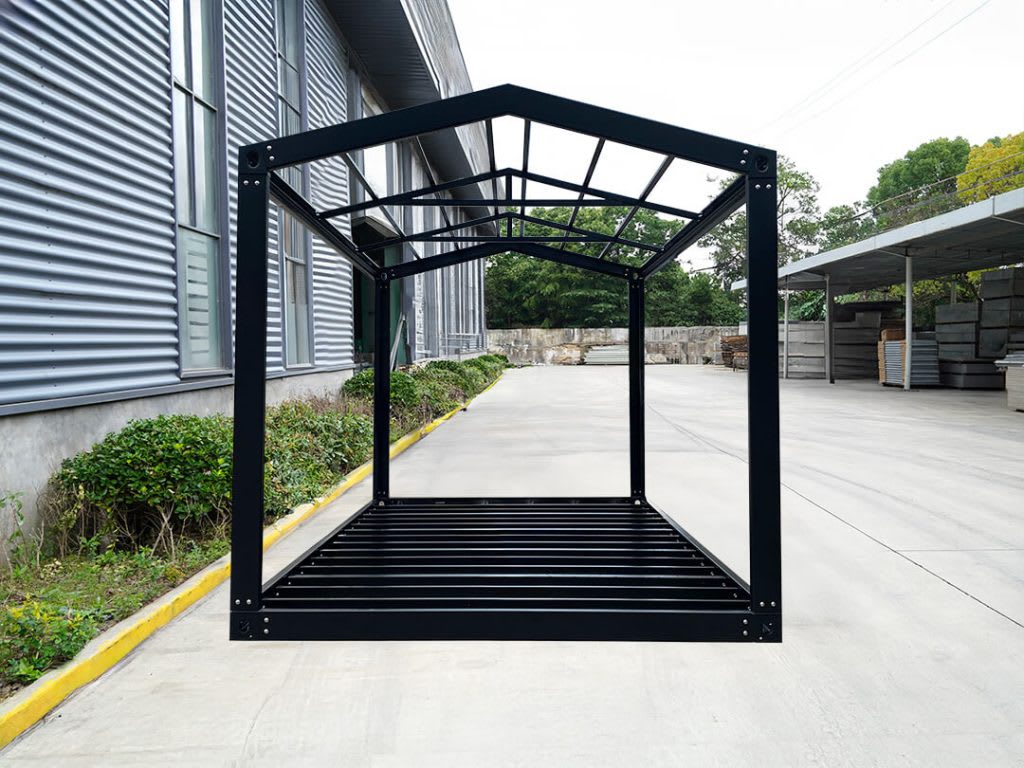
The same 6m x 3m frame comes in three roof profiles on the identical footprint and steelwork. The flat roof (R1R) is the compact base at 2,700 mm. The skillion roof (R1S) slopes from 2,650 to 3,000 mm to shed water. The pitched roof (R1T), an A-frame, runs 2,720 to 3,070 mm for more overhead space. All three take the same cladding, roof and flooring, and frames join or cut to size for larger builds.

Build
Every frame is a flat pack container frame: it ships in a steel crate and bolts together without welding. The galvanised steel carries a four-layer powder coat, and most kits assemble in a few hours with basic equipment. It takes a 19 or 25 mm subfloor, 50 mm EPS or framed walls, and a Colorbond roof. SCS builds at its own Yixing, Jiangsu factory; every FlexiFrame order ships with a new 40ft High Cube container, and sold-separately shower modules and PA doors with a new 20ft General Purpose container.
Compliance
A container frame is a structural component, so compliance sits with the completed building rather than the kit alone. In Australia that means the National Construction Code (NCC 2022). The cold-formed steel sections are designed to AS/NZS 4600, the structure's load actions, including Region D cyclonic wind in cyclone-prone areas, to AS/NZS 1170, and the galvanised corrosion protection to AS/NZS 4680. Final approval for container frames in Australia rests with the local council or building surveyor, and what's required depends on the state, the land zoning and the finished use. The maritime container marks you see on freight containers cover shipping, not steel building frames, so they don't apply here. What matters is the structural and building compliance of the finished structure on the frame.
 ISO
ISO  Bureau Veritas
  DNV
DNV  Lloyd's Register
  BIC
BIC  ABS
ABS Standards & References
A container frame is a structural component. The standards below govern the steelwork and the completed building. Click through to the source authority for the full text and current revision.
Available Separately
A FlexiFrame is the structural shell. These parts are supplied separately to clad, line and finish it into a building. Most pack one to a 40ft container, while shower modules and PA doors ship in a 20ft.
Personnel access door with handle and deadlock. Ships in a 20ft container.
2,900 x 1,150 mm, 50 mm core with 0.6 mm steel skins.
2,450 x 950 mm, 50 mm core with 0.6 mm steel skins.
6 m length, 50 mm, for edges and corner trim.
6 m length, 50 mm, for panel edging and joins.
18 x 1,147 x 3,000 mm, for flooring or lining.
1,000 x 1,000 x 2,100 mm pre-fitted shower unit. Ships in a 20ft container.
Downloads
Spec sheet and assembly guide for the flat, skillion and pitched container frames, on request.
Related Products
Container frames are part of the SCS relocatable-build range. All are built factory-direct and shipped to site.

Fixed-size homes built from new Hi-Cube containers, fitted out factory-direct.
container homes
Pop-out homes that expand on site for more floor space from a transportable footprint.
expander homes
Standalone bathroom units, factory-plumbed and shipped to site.
portable bathroomsFAQ
Three questions buyers ask most often about container frames.
A container frame is the structural steel shell for a relocatable or modular building. Builders and resellers use it for tiny homes, site offices, granny flats, carports, modular extensions and pop-up retail, cladding and fitting it out to suit the project.
Most kits bolt together in a few hours with basic equipment and no welding. The frame arrives flat-packed in a steel crate with 8 lifting points, so the main on-site work is setting the crate down, bolting the frame up and squaring it before you clad and roof it.
All three share the 6m x 3m footprint and steelwork. The flat roof is the compact, economical base at 2,700 mm. The skillion roof slopes from 2,650 to 3,000 mm to shed water. The pitched A-frame runs 2,720 to 3,070 mm for a residential look and more overhead space.