Flammable Storage Containers: Class 3 DG Compliant
- DG class
- Class 3 flammable
- Standard
- AS 1940:2017
- Bund
- 800 L / 1,200 L
- Sizes
- 10ft / 20ft / side-open
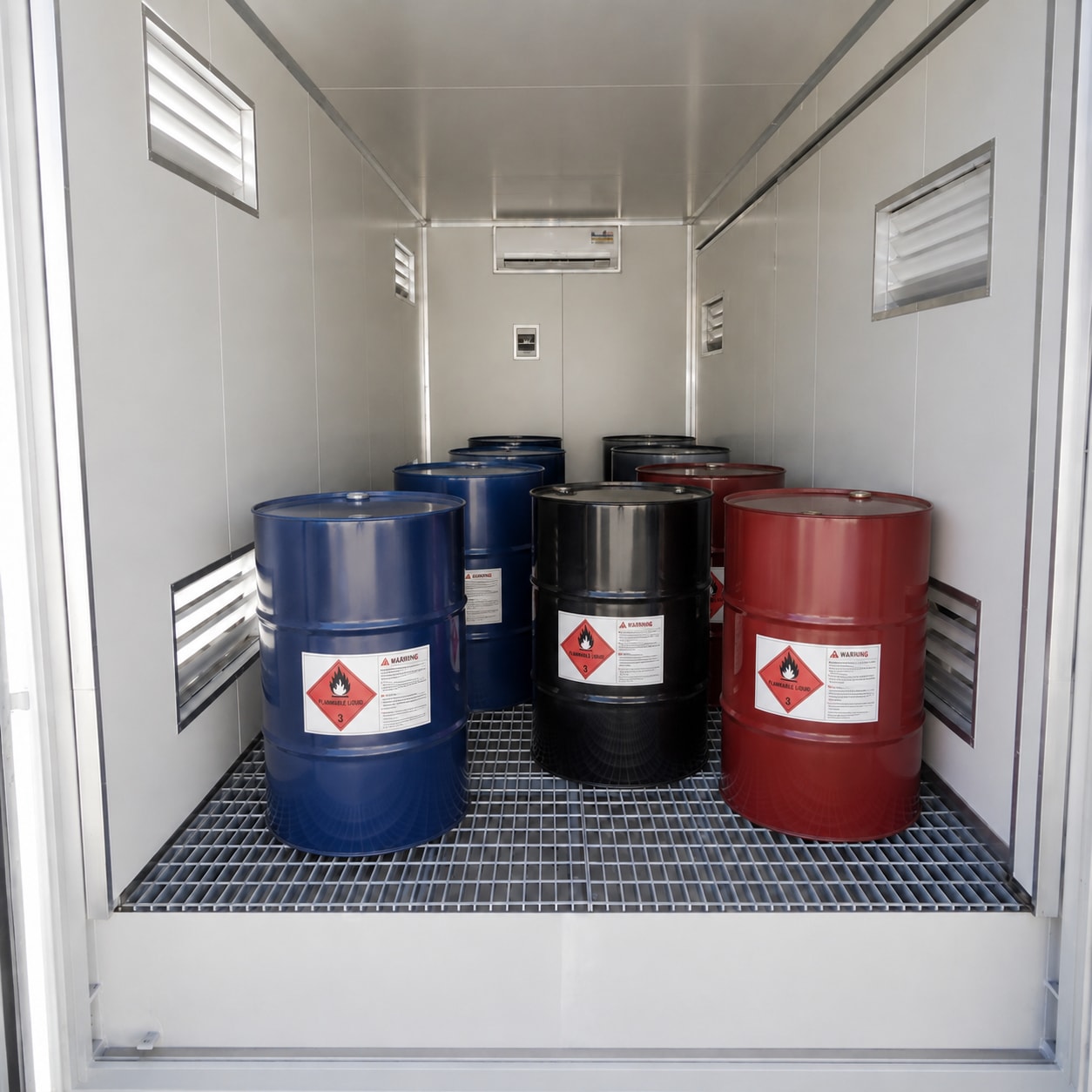
Bunded, ventilated steel store with a non-spark mesh floor and lockable stainless decant valve. Built 10ft (approx 4,000 L), 20ft (approx 10,000 L), and 20ft side-opening with twin-folding side doors for full-bay forklift and drum access.
Built to AS 1940:2017, the controlling Australian standard for flammable and combustible liquids: secondary containment, high and low ventilation, ignition-source control, and Class 3 signage. Certificate of Compliance per unit on request.
Mining fuel bays and lube stores, construction fuel-and-flammables compounds, and onshore energy decant and workshop-solvent duty. Relocatable on forklift pockets and lifting eyes, away from ignition sources.
Overview
Class 3 flammable liquid storage, factory-direct
A Class 3 flammable liquid storage container is a bunded, ventilated steel store engineered to hold petrol, diesel additives, solvents, and other Class 3 dangerous goods in compliance with AS 1940:2017. SCS Global builds these flammable storage containers factory-direct from our Yixing, Jiangsu facility in 10ft, 20ft, and 20ft side-opening configurations. Operators on mining, construction, and industrial sites use them to hold fuels, solvents, and drummed or IBC flammables outdoors, away from ignition sources. Every unit sits inside our range of dangerous goods containers and ships with a Certificate of Compliance on request. Above placard quantities, Class 3 flammable and combustible liquids have to be held in a compliant store with four controls in place: secondary containment, ventilation, ignition-source control, and Class 3 signage, all engineered into one relocatable unit built to the controlling standard.
Specifications
Container Specifications for Flammable Liquid Storage
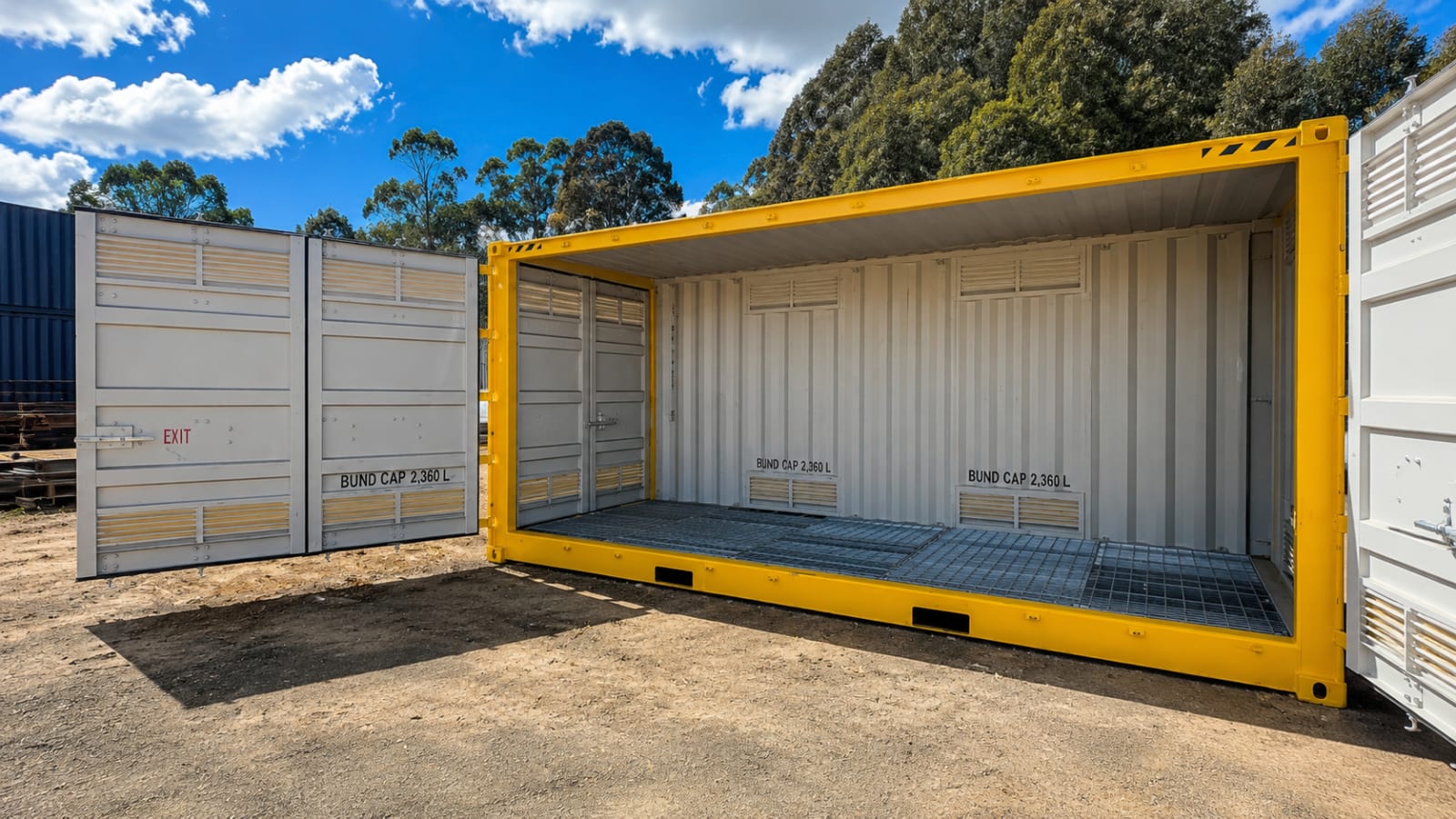
SCS builds flammable liquid storage containers in 10ft, 20ft, and 20ft side-opening configurations, each with an integrated steel bund and a non-spark mesh floor. The side-opening 20ft adds twin-folding side doors for full-bay forklift and drum access. Offering all three sizes off one line is something only a manufacturer does: the bund, floor, ventilation, and signage are identical on every size.
| Specification | Value |
|---|---|
| Flammable storage capacity | 10ft approx 4,000 L; 20ft and 20ft side-opening approx 10,000 L |
| Bund capacity (secondary containment) | 800 L (10ft); 1,200 L (20ft and 20ft side-opening) |
| External dimensions (L x W x H) | 2.99 x 2.44 x 2.90 m (10ft); 6.06 x 2.44 x 2.90 m (20ft and side-opening) |
| Doors | Double-opening end doors (10ft and 20ft); end doors plus twin-folding side doors (20ft side-opening) |
| Handling | Forklift pockets and lifting eyes; full-bay forklift and drum access on the side-opening build |
| Floor system | Fully welded steel floor on an RHS frame, non-spark industrial mesh over an integrated front steel bund wall (no timber) |
| Decant valve | Lockable stainless-steel valve under the rear sill |
| Material | Corten steel, marine-grade components |
| Ventilation | High and low passive vents (mechanical extraction fan optional) |
| Signage | Class 3 placards plus No Smoking, No Naked Flame, and Keep Fire Away |
| Controlling standard | AS 1940:2017 |

Requirements
Class 3 Flammable Liquid Storage Requirements
The Class 3 flammable liquid storage requirements Australia enforces come from AS 1940:2017 and state work health and safety regulations. Above placard quantities, Class 3 liquids must sit in a compliant store with four controls: secondary containment sized to retain a spill, high and low ventilation to clear heavier-than-air vapour, ignition-source control through a non-spark floor and separation distances, and Class 3 placards and signage. The duty sits with the operator, and a containerised store delivers all four in one engineered, relocatable unit built to AS 1940:2017.

Safety Features
Ventilation, Bunding, and Safety Features
Every unit disperses heavier-than-air flammable vapour through high and low passive vents. Vapour pools at floor level, so the store vents low on the walls, the detail most cabinet products miss. A fully welded steel floor with non-spark mesh and no timber drops spills into the integrated bund, 800 L on the 10ft and 1,200 L on the 20ft, drawn off through a lockable stainless valve. Each bund is leak-tested before it leaves the factory, and factory options add forced extraction, a fire-rated build, shelving, and air conditioning.
Compliance
AS 1940 Compliance for Containerised Flammable Storage
AS 1940:2017 is the Australian standard for storing and handling flammable and combustible liquids. For a containerised store it governs bunding, ventilation, ignition-source control, separation distances, and signage, so compliance is engineered into the box, not bolted on. The standard sets the secondary-containment rule: the bund must be sized to retain a spill, which on our units holds 800 L on the 10ft and 1,200 L on the 20ft. The exact spill-compound sizing rule, and how it applies to drummed and IBC inventory, is worked through in the full AS 1940 explainer. Where a store also holds Class 8 corrosives or mixed classes, AS 3780:2023 and AS 3833:2024 apply alongside it. SCS supplies a Certificate of Compliance with each unit on request, built and certified through our factory-direct manufacturing and third-party inspection process.
 ISO
ISO  Bureau Veritas
  DNV
DNV  Lloyd's Register
  BIC
BIC  ABS
ABS Standards & References
Standards we build to
Class 3 flammable storage is governed by AS 1940, with AS 3780 and AS 3833:2024 applying where corrosives or mixed classes are co-stored. Click through to the source authority for the current revision.
Applications
Applications: Mining, Construction, and Industrial
SCS deploys these Class 3 DG stores across mining, construction, and industrial sites, anywhere fuel, solvents, or flammable liquids are stored or decanted in the field. Most sites run more than one DG class, so the flammable store pairs with corrosive and chemical storage for mixed inventory.
Mining & Resources
Diesel additives, lubricants, and solvents held next to fuel bays and lube stores on remote mine sites, bunded and ventilated to AS 1940.
Construction & Infrastructure
A fuel and flammables compound that keeps Class 3 inventory off the open laydown and inside the site DG management plan, relocatable as the build moves.
Oil, Gas & Energy
Decant and workshop-solvent duty for onshore energy and processing operations, with forced ventilation where a risk assessment requires it.
Military & Defence
A compliant, placarded Class 3 store for fuels and solvents on defence and government sites, ventilated and bunded to AS 1940.
Tell us your Class 3 inventory, size, and site, and SCS quotes the AS 1940 build factory-direct.
Engineering Resources
Download technical documentation
Three-size spec sheet, AS 1940 compliance summary, and CAD drawing for engineering review. Each is produced at project handoff and is not gated.
Flammable Liquid Storage Spec Sheet
3-size specification matrix and AS 1940 compliance summary.
DownloadAS 1940 Compliance Summary
One-page summary of AS 1940:2017 containment, ventilation, ignition control, and signage rules.
DownloadFlammable Storage CAD Drawing
Plan, elevation, and section drawings for engineering reference.
DownloadRelated Products
Explore the DG range
Sister products and guides in the SCS dangerous goods container range, built on the same Yixing line against the same compliance baseline.
10ft Dangerous Goods Container
Compact bunded Class 3 unit for tight worksites, depots, and smaller flammable volumes. AS 1940 bunding, ventilation, and signage.
10ft dangerous goods container
20ft Dangerous Goods Container
Full-size bunded store for bulk flammable inventory and drum or IBC loads. AS 1940 compliant, multiple door configurations.
20ft dangerous goods container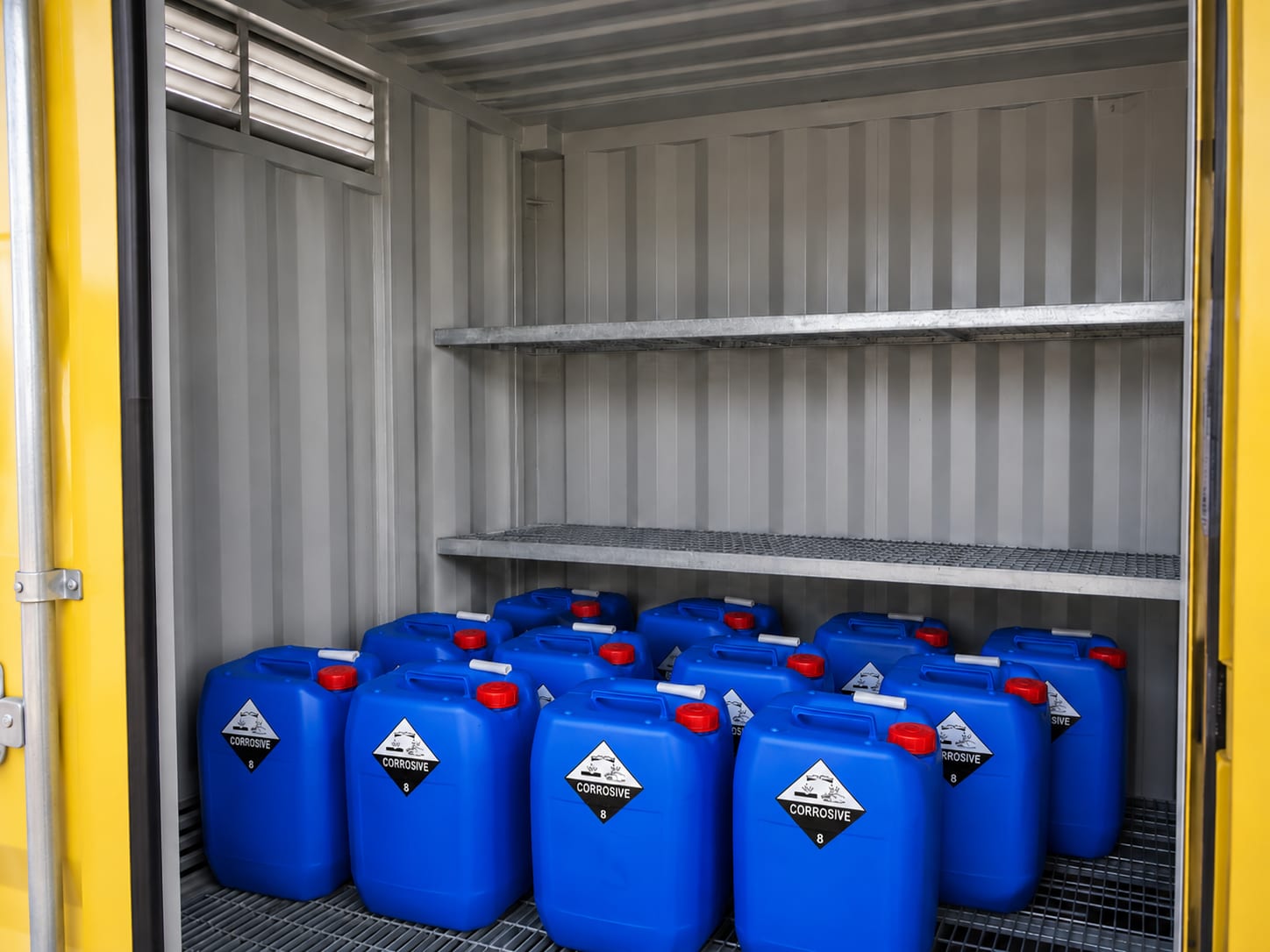
Corrosive Storage (Class 8)
Chemical-resistant lined storage for acids and bases. AS 3780-aligned sump depth, doors, and ventilation.
corrosive storage
Chemical Storage Containers
Broader chemical storage range across single-class and mixed-class deployments.
chemical storage containers
DG Classification and Compliance Guide
Class-by-class storage rules and the AU/NZ standards that govern DG storage.
dg classification and compliance guide
Bunded vs Unbunded Storage
When secondary containment is required and how a bund is sized to your inventory.
bunded vs unbunded storageFAQ
Frequently Asked Questions
Five questions procurement and HSE teams ask most often about Class 3 flammable liquid storage.
What is a Class 3 flammable liquid?
A Class 3 flammable liquid is a liquid with a flash point at or below 60 degrees C, the temperature at which it gives off enough vapour to ignite. Common examples are petrol, many diesel additives, acetone, methanol, and most solvents and thinners. Class 3 is one of the nine UN dangerous goods classes.
How should flammable liquids be stored on site?
Flammable liquids are stored in a bunded, well-ventilated store, separated from ignition sources and incompatible goods, with Class 3 signage in place. Above placard quantities, that means a compliant DG store rather than a shelf or open yard. The full AS 1940 compliance requirements set out the detail.
What is AS 1940?
AS 1940:2017, The Storage and Handling of Flammable and Combustible Liquids, is the controlling Australian standard for Class 3 storage. Published by Standards Australia, it governs bunding, ventilation, ignition-source control, separation distances, and signage.
Can you store flammable liquids in a shipping container?
Yes, in a purpose-built compliant unit. A standard shipping container is not suitable, but a Class 3 DG store, bunded, ventilated with high and low vents, fitted with a non-spark floor and Class 3 signage, is. SCS builds these in 10ft, 20ft, and 20ft side-opening sizes.
Should flammable liquids be stored in a cabinet or a container?
A safety cabinet suits small indoor volumes, typically a few hundred litres in a workshop or laboratory. A containerised store suits bulk and outdoor site storage: drums, IBCs, and thousands of litres, with integrated bunding and full ventilation. The volume, location, and your AS 1940 obligation decide which one fits.